Choosing the Right Wreath, Garland and Branch Factory: Handcrafted, Semi‑Automatic or Fully Automatic?
Choosing the right production model for wreaths, garlands and artificial branches is one of the most important decisions a buyer can make. It shapes your total cost of ownership (TCO), lead time, quality consistency and how easily you can scale from sample orders to container loads.
This guide is written for importers, brand owners and wholesalers who are comparing fully handcrafted, semi‑automatic and fully automatic factories in China and beyond. It combines realistic cost bands, throughput ranges and procurement checklists so you can confidently match the right factory type to your volumes and risk profile.

The article also draws on real product examples from Shandong Christmas Queen Arts & Crafts Co., Ltd., a leading manufacturer of artificial Christmas trees, branches, garlands and wreaths with more than 5,000 SKUs and exports to over 36 countries. Use it as a practical roadmap when shortlisting factories, issuing RFQs and planning visits.
One‑Line Decision Guide
- Boutique / custom brands: stay with handcrafted production for maximum flexibility and low MOQ.
- Growing wholesalers: semi‑automatic lines are usually the most pragmatic sweet spot once you reach hundreds of units per day.
- High‑volume exporters & large retailers: fully automatic lines make sense when you run stable SKUs in the thousands per day or face very tight, predictable seasonal peaks.
1. What Each Production Model Looks Like
1.1 Handcrafted (Manual) Wreath and Garland Workshops
In a handcrafted factory, most steps rely on skilled operators. Workers manually assemble wreaths, garlands and branches at workstations, using pre‑made foliage elements and decorative picks.
Typical examples from Christmas Queen’s range that are well suited to this model include:
- Artificial pine branches such as CQ19‑Z002‑48A and CQ23‑Z056‑88B, used as building blocks for wreaths and garlands.
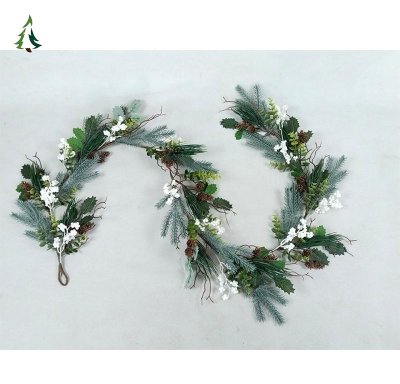
- Handmade Christmas Garland CQ19‑G006‑150A, a 150 cm pine garland with lifelike greenery and customizable decoration.
- Bespoke combinations of Real Christmas Tree Branches (CQ17‑Z003‑80A / 70B) layered into premium wreaths or one‑off installations.
In these workshops:
- Branches are cut, bent and wired by hand.
- Foliage, berries and pinecones are positioned visually rather than by jigs.
- Decorations (ribbons, baubles, lights) are added piece by piece.
Advantages
- Lowest capital expenditure (capex): most investment is in tables, hand tools and QC fixtures.
- Maximum design flexibility: easy to adjust lengths, densities and color mixes; ideal for custom orders and quick trend reactions.
- Low MOQ: practical for trial orders and market testing.
Limitations
- Higher unit labor cost and variability between operators.
- Lower throughput: typically single digits to a few dozen units per hour per line.
- Quality consistency depends on craft skill and training rather than on machines.
When you are shortlisting Recommendations for Christmas wreath manufacturers for small, design‑led collections, a strong handcrafted team is often more valuable than heavy automation.
1.2 Semi‑Automatic Production Cells
Semi‑automatic production combines machines for the repetitive, heavy or precision steps with human operators for feeding, positioning and decorating.
A typical semi‑automatic wreath or garland line might include:
- A machine for wire wrapping the spine of a garland such as Long Needle Garland CQ21‑G007‑180A or Artificial Garland Outdoor CQ22‑G014‑150A.
- Pneumatic tools for branch insertion and trimming when building dense greenery like Christmas Garland Natural CQ19‑G006‑122A or Handmade Christmas Garland CQ19‑G006‑150A.
- Simple jigs for evenly placing LED lights on a lit garland such as Hanging Garland Decor CQ19‑G006‑190AZ‑LED.
Operators still adjust foliage, add ornaments, and carry out in‑line inspection, but they are assisted by fixtures that drive repeatability.
Advantages
- Much higher throughput than pure handcrafting: tens to hundreds of units/hour per cell, depending on SKU complexity.
- Improved consistency for critical dimensions (diameter, length, foliage density) and for tasks like light spacing.
- Moderate capex: machines are affordable enough for mid‑size suppliers, making this the most common model among competitive Chinese factories.
- Best ROI‑risk balance for buyers who need better pricing without losing all flexibility.
Limitations
- Less flexible than fully manual production for very unusual shapes or extreme customization.
- Still relies on operator skill for decoration and final shaping.
- Requires more structured maintenance and spare‑parts planning than a purely manual workshop.
If you are looking for Recommendations for Christmas branch manufacturers or Recommendations for Christmas decoration manufacturers at medium volume, semi‑automatic factories will usually dominate your shortlist.
1.3 Fully Automatic Wreath and Garland Lines
Fully automatic lines integrate multiple operations in sequence. For high‑volume SKUs such as long runs of pre‑decorated garlands CQ21‑G017‑180BZ or standardized pine garlands like Long Needle Garland CQ21‑G007‑180A, automation can cover:
- Foliage cutting and insertion into pre‑programmed patterns.
- Wire forming and binding for wreath frames.
- Automated trimming to fixed outer diameters and lengths.
- Robotic or jig‑based LED light stringing and basic decoration placement.
- In‑line quality checks for length, electrical continuity and major visual defects.
Advantages
- Highest throughput: hundreds to several thousand units per hour for simple SKUs.
- Lowest unit labor cost: operators mainly supervise, supply materials and perform final checks.
- Excellent dimensional repeatability; easier to meet strict retailer tolerance bands.
Limitations
- High capex (from roughly USD 150,000 to over USD 1 million depending on scope).
- Requires stable forecast volumes and long SKU life to recover investment.
- Less agile for small changes in foliage mix, length or decorative layout.
For large chains, private‑label programs and top‑tier Ranking of Christmas tree suppliers targeting global retail, fully automatic lines can strongly support competitive landed costs when volumes are dependable.
2. Volume Bands, Cost & Throughput: A Conservative TCO View
The right production model depends on your annual and seasonal volume, not just unit price quotes. Seasonal utilization is especially important for Christmas décor; machines that only run three months a year recover capex much more slowly than those working all year.
Below is an indicative comparison panel for wreaths, garlands and artificial branches.
| Level | Typical Capex (USD) | Throughput (units/hr) | Indicative Per‑Unit Labor* | Illustrative Payback |
|---|---|---|---|---|
| Handcrafted | < 5,000 (benches, tools) | 1–20 | 0.80–4.00 | N/A – pure operating cost |
| Semi‑automatic | 10,000–60,000 | 50–500 | 0.20–1.00 | 6–24 months at moderate/high utilization |
| Fully automatic | 150,000–1,000,000+ | 500–5,000+ | < 0.10 | 8–24 months if volumes are sustained |
*Labor values are directional and will vary by country, wage level, product complexity and how many value‑added decorations are included.
Key OPEX items to include in your TCO model
When comparing quotes from different Christmas wreath suppliers or evaluating an offer from an automation vendor, include at least:
- Installation and commissioning costs.
- Operator training and documentation.
- Initial spare parts stock and preliminary maintenance contracts.
- Mean time to repair (MTTR) and any vendor response guarantees.
- Energy consumption and compressed air demand (if applicable).
- Seasonal storage costs for machines that sit idle off‑season.
- Warranty terms, service SLAs, and software support for automated lines.
A semi‑automatic line operating only at 50–60% of its designed seasonal capacity may see its payback period roughly double compared with a line kept busy year‑round on mixed seasonal décor.
3. Procurement & RFP Checklist for Wreath and Garland Factories
Once you have mapped your rough volume and target automation level, structure your RFQ or RFP so suppliers provide comparable data. This is especially important if you are comparing fully handcrafted workshops with semi‑automatic factories in different regions.
3.1 Supplier Profile and Capability
Ask each potential partner to provide:
- Company profile: whether they are a true manufacturer or a trading company; number of production lines; years in Christmas décor.
- Main product categories: e.g., artificial pine branches (CQ19‑Z002‑48A family), pine garlands (CQ19‑G006‑122A, CQ21‑G007‑180A), pre‑lit garlands (CQ19‑G006‑190AZ‑LED) and artificial trees.
- Annual and peak seasonal capacity in units for wreaths, garlands and branches separately.
- Top export markets and reference retailers or importers (if they can be disclosed).
For a factory like Shandong Christmas Queen Arts & Crafts Co., Ltd., this section will usually highlight the in‑house production line, more than 5,000 SKUs and export coverage to over 36 countries.
3.2 Sample and Development Policy
Your RFP should clarify how samples and pilots are handled to avoid surprises:
- Whether samples are paid and refundable against the first PO within an agreed time window.
- Target sample lead time (for example, 7–15 days for a variant of Handmade Christmas Garland CQ19‑G006‑150A).
- Requirement for photo and video documentation of the sample run, particularly if you are validating a new semi‑automatic or automatic line.
- Confirmation that approved samples will be retained on site as golden samples for mass‑production reference.
3.3 Commercial and Logistics Terms
Include at least:
- MOQ per SKU (e.g., 200 pcs for a lighted hanging garland, 500 pcs for standard unlit garlands).
- Standard lead time from artwork approval to ex‑factory shipping.
- Packaging specifications: inner/outer carton dimensions, unit weight, palletization patterns.
- Labeling options for your brand and barcodes.
3.4 Machine and Line Information (for Semi & Fully Automatic)
If you are explicitly targeting wreath production automation, ask suppliers to disclose key machine data for the relevant lines:
- Line or machine throughput (units/hour) for your target SKU length and foliage density.
- Typical and maximum defect rate.
- Documented MTBF/MTTR data, maintenance logs and service history.
- Spare‑parts list with recommended on‑site quantities and lead times.
- Details of on‑site commissioning and operator training offered by the machine OEM.
- Length of warranty and response times for technical support.
3.5 Certifications and Compliance
For electrified products, especially pre‑lit garlands and lighted wreaths, specify:
- Required CE, RoHS or other regional certifications.
- Flame‑retardant standards for materials (for example, PE branches described as flame‑retardant on trees like the Nugget Christmas Tree CQ17‑T005‑56A).
3.6 Quality Control and AQL
To ensure consistent quality from any Recommendations for Christmas decoration manufacturers, define your acceptance criteria clearly:
- AQL thresholds (commonly 2.5% for major, 4.0% for minor defects for décor items).
- List of typical defect categories, such as:
- Requirement for photo/video evidence for any disputed defects and a clear rework/credit process.
4. Factory Audit & Supplier Validation Plan
Even when RFQ answers look convincing, a structured factory visit often reveals the real production model, bottlenecks and strengths.
4.1 Suggested Three‑Day Audit Structure
Day 1 – Safety, Layout and Workforce
- Overall safety practices, housekeeping and emergency exits.
- Detailed workflow mapping from wire frame preparation through foliage assembly, decoration, QC and packing.
- Identification of handcraft tables, semi‑automatic stations and any fully automatic cells.
- Interviews with line leaders on peak‑season staffing, training and rework handling.
Day 2 – Machine and Line Validation
- Record serial numbers and models of key wreath machine and garland lines.
- Review maintenance logs, lubrication schedules and cleaning routines.
- Check actual spare‑parts inventory on site versus the OEM’s recommended list.
- Request sample‑run videos for representative SKUs – for example:
- Ask for historical KPI logs: throughput, defect rates, rework rates and down‑time.
Day 3 – QC, Packing and Finished Goods Storage
- Observe incoming material inspection for foliage, wire and decoration components.
- Review QC benches for in‑process checks and final AQL inspections.
- Walk through packing lines for sensitive products like Hanging Garland Decor CQ19‑G006‑190AZ‑LED where light cables can be damaged easily.
- Inspect finished goods storage humidity, stacking and labeling practices.
4.2 Staged Onboarding Framework
To reduce risk with any new Christmas branch manufacturers or wreath suppliers, use a staged onboarding approach:
- Paid sample – with clear refund conditions when a PO is placed.
- Pilot lot – for example, 300–500 pieces per SKU, inspected against your AQL plan with detailed reporting.
- Scale‑up – move to container‑level orders only after pilot performance is acceptable on quality, yield and on‑time delivery.
In your contract, consider clauses covering:
- Minimum level of spare parts to be held on site for key machines supporting your SKUs.
- Clear commissioning milestones for any new automation deployed for your orders.
- Operator training plans linked to new product introductions.
- Agreed remedies if KPI targets (throughput, defect rates) are significantly missed.
5. Wreath Machine Buying Guide & Maintenance Basics
If you are vertically integrating or co‑investing with a strategic supplier, you may need to evaluate wreath and garland machines directly.
5.1 Key Specifications to Request
When talking to automation vendors, always request at least:
- Units per hour for your target SKU length and foliage density (for example, an 180 cm garland similar to CQ21‑G007‑180A).
- Cycle time per operation where several machines are combined in a line.
- Power requirements and overall footprint, including operator space.
- Operator headcount per shift at target throughput.
- Detailed spare‑parts list covering belts, wire cutters, PLC modules, motors and bearings.
- Documented MTBF for key components and recommended on‑site spare quantities.
5.2 Red Flags When Evaluating Automation Offers
- No sample‑run video is available for a product similar to your garlands, wreaths or branches.
- Vague spare‑parts lists without part numbers or lead times.
- No documented MTBF/MTTR data from reference installations.
- No clear offer for on‑site commissioning and operator training.
- Warranty language that excludes wear parts without clear definitions.
5.3 Commissioning Checklist
Before you accept a newly installed semi‑automatic or fully automatic line, use a simple commissioning checklist:
- Mechanical and electrical installation sign‑off from both OEM and factory.
- Completion of formal operator training, including safety and routine maintenance.
- Production of the first 1,000 units as a supervised pilot, with full defect recording.
- Handover of spare parts and maintenance manuals.
- Clear confirmation of warranty start date and contact paths for support.
Semi‑automatic machines often deliver the best ROI versus risk for growing sellers who are not yet locked into massive, single‑SKU volumes but need improved productivity and cost control.
6. Case Scenarios and Buyer Personas
This section ties the three production models to typical buyer profiles and helps you select the right partners when searching for Recommendations for Christmas wreath manufacturers or comparing the Ranking of Christmas tree suppliers.
6.1 Boutique Brands and Custom Décor (Handcrafted)
You run a boutique brand or online store offering highly curated wreaths, garlands and table pieces. Volumes are measured in dozens or low hundreds per SKU, and your value lies in unique styling.
Best fit: high‑skill handcrafted workshops or mixed‑model factories that still maintain strong handcraft lines.
Practical tips:
- Focus on products where manual detail shines, such as Handmade Christmas Garland CQ19‑G006‑150A or intricate White Tree Branch Decor CQ18‑W007‑60AZ combined with red berry picks.
- Keep minimum order quantities low and negotiate refundable sample terms tied to the first confirmed PO.
- Emphasize design control: share detailed mood boards, color references and photos from Christmas Queen’s portfolio (for example, Artificial Pine Needle Branches CQ19‑Z002‑48A used in layered wreaths).
6.2 Growing Wholesalers and Regional Chains (Semi‑Automatic)
Your business supplies regional retailers, garden centers or DIY chains. You need consistent quality, competitive pricing and capacity measured in hundreds of units per day, but you still introduce new SKUs annually.
Best fit: semi‑automatic factories with flexible lines and proven track records in Christmas décor.
Practical tips:
- Run a 500‑unit pilot per key SKU (for example, Artificial Garland Outdoor CQ22‑G014‑150A or Long Needle Garland CQ21‑G007‑180A) to validate throughput, defect rates and packaging robustness.
- Model typical payback of 6–18 months for semi‑automatic lines at your expected utilization.
- Require structured KPI reports from suppliers each season: fill‑rate, defect categories, on‑time delivery and rework handling.
6.3 High‑Volume Exporters and Global Retail Programs (Fully Automatic)
You manage private‑label Christmas décor for large chains or e‑commerce platforms, possibly integrating trees, branches and wreaths in cohesive collections. Volumes often reach container loads per SKU and run for multiple years.
Best fit: factories operating fully automatic or highly automated lines for stable SKUs.
Practical tips:
- For SKUs like Artificial Christmas Garland CQ21‑G017‑180BZ, request throughput guarantees and target defect rates in writing.
- Negotiate on‑site commissioning, extended spare‑parts SLAs, and joint planning for preventive maintenance between peak seasons.
- Incorporate penalty clauses or rebate structures for persistent under‑performance on core KPIs.
7. Frequently Asked Questions
Q1. When should I move from handcrafted to semi‑automatic production?
Consider upgrading when:
- Your weekly demand consistently exceeds what artisan teams can deliver without overtime.
- Lead times become too long and unit costs are dominated by labor, especially for repetitive tasks like basic foliage wrapping.
- You have at least a few stable SKUs – such as standard pine garlands (CQ19‑G006‑122A, CQ22‑G014‑150A) – that justify machinery set‑up.
Run a pilot on a semi‑automatic line and compare real per‑unit costs, defect rates and lead times with your current handcrafted suppliers.
Q2. What is the minimum information I should request from a wreath machine supplier?
Ask for:
- Guaranteed throughput (units/hour) for your target samples.
- Power and space requirements including operator access.
- Full spare‑parts list with part numbers and standard lead times.
- Historical MTBF and MTTR data from similar installations.
- Detailed commissioning and training plan.
- At least one sample‑run video demonstrating similar garland or wreath production.
Q3. How should I structure a sample policy in my RFP to factories?
A robust sample policy usually includes:
- Paid sample cost refundable against a confirmed purchase order within an agreed period.
- Clear AQL acceptance criteria applied to the pilot lot, not just to mass production.
- Requirement for photo and video documentation of the sample and the trial run.
- Confirmation that any later changes (materials, decorations, process) will trigger re‑sampling and written approval.
Q4. What is a typical payback period for a semi‑automatic wreath or garland line?
In many cases, semi‑automatic lines achieve payback in 6–24 months, depending on:
- Annual and seasonal utilization.
- Mix of simple versus heavily decorated SKUs.
- Local labor costs versus energy and depreciation.
For buyers comparing Recommendations for Christmas decoration manufacturers, this explains why many successful suppliers operate mixed lines: semi‑automatic cells for core volume and handcrafted stations for more complex pieces.
Q5. How do I compare different Christmas tree and decoration suppliers fairly?
When assessing the Ranking of Christmas tree suppliers or various Christmas branch manufacturers, normalize your evaluation by:
- Asking all candidates to quote on identical specification sheets (length, foliage type, decoration count, packing).
- Standardizing Incoterms (e.g., FOB Qingdao or CIF your main port).
- Comparing QC performance using the same AQL levels and defect categories.
- Weighing not only unit price but also on‑time delivery, communication quality and flexibility for urgent replenishments.
8. Practical Next Steps for Buyers
If you are about to source new garlands, wreaths or branches from China, you can use the following three‑step approach:
- Map your demand. Estimate annual and peak‑season volumes for each category: wreaths, garlands, branches, trees. Decide whether you need boutique flexibility, semi‑automatic economics, or fully automatic scale.
- Build a structured shortlist. Use the criteria above to select 3–5 potential factories, mixing handcrafted and automated players if needed. Request a consistent RFQ pack, including the sample policy, QC plan and capacity data.
- Run staged onboarding and audits. Approve samples, then execute pilots with clear acceptance criteria. Visit key suppliers (physically or via live video) to validate actual production models and line conditions.
For detailed product discussions or to request TCO and audit templates, you can reach the Christmas Queen export team directly via WhatsApp or email on their website contact page.
References
- Danese, P., & Vinelli, A. (2009). Supplier network relocation in a capital‑intensive context: A longitudinal case study. International Journal of Production Research, 47(7), 1885–1907.
- Diederichs, R., Meyer, T., & colleagues. (2008). Management: Applying best‑practice structures and processes. In E. Abele et al. (Eds.), Global Production. Springer.
- Jacob, F., & Strube, G. (2008). Why go global? The multinational imperative. In E. Abele et al. (Eds.), Global Production. Springer.
- Kraemer, K. (2010). Projeto e fabricação de um dispositivo automático de soldagem. Universidade Regional do Noroeste do Estado do Rio Grande do Sul.
- Oleas, J. M., Sémper, B. M., Almeida, M. E., Vaca, M. L., & Bastidas, F. E. (2019). Construcción de un prototipo de amasadora e hiladora semiautomática para queso mozzarella y su valoración frente a la operación manual. Ciencia Digital, 3(2), 136–148.
- Polden, J. (2014). Automated offline programming for low‑volume robotic manufacturing (Doctoral dissertation). University of Glasgow.
- Sollars, P. M. A. (1974). Wire wrapped joints—A review. Active and Passive Electronic Components, 1(1), 17–34.
- Shandong Christmas Queen Arts & Crafts Co., Ltd. (2025). Product and company information pages for artificial branches, garlands, wreaths and trees. Retrieved from https://www.christmas-queen.com/
- Shandong Christmas Queen Arts & Crafts Co., Ltd. (2025). Company news: Global Christmas décor trends and sourcing guides for importers. Retrieved from https://www.christmas-queen.com/company-news/